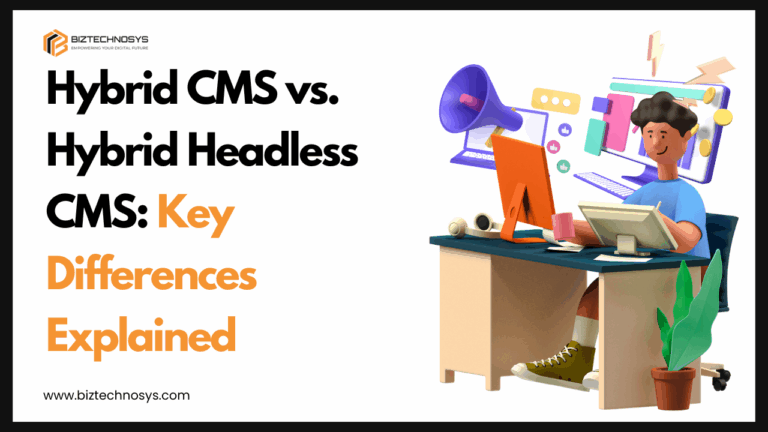
Choosing the right content management system (CMS) is critical for businesses aiming to deliver content across multiple channels while balancing developer flexibility and marketer ease. In today’s digital-first world, delivering seamless, personalized experiences requires not only great content but also the right infrastructure. In this blog, we’ll break down the differences between Hybrid CMS vs. Hybrid Headless CMS, helping you decide which one fits your goals best.
A headless CMS is a back-end-only content management system that separates content creation from content presentation. Unlike traditional CMSs, which couple the backend (where content is created) with the frontend (where it is displayed), a headless CMS decouples these layers, allowing content to be served anywhere via APIs.
Popular examples include Contentful, Strapi, and Sanity.
Omnichannel Delivery: Publish content across websites, mobile apps, kiosks, digital signage, smartwatches, and even IoT devices.
Developer Flexibility: Frontend developers can use any modern framework like React, Angular, Vue, or Svelte, instead of being locked into a templating language.
Scalability: API-driven architecture allows you to scale easily as your content distribution grows.
Future-Proof: Easily integrate with new platforms, devices, and technologies like AR/VR.
Improved Security: Since the presentation layer is separate, it’s less prone to traditional website vulnerabilities.
Continue reading about Why Choose a Drupal Development Company in Canada? with this link.
Limited Marketer Usability: Marketers may find it hard to preview content or make quick changes without involving developers.
Complex Setup: Developers need to build and maintain the frontend and manage integrations.
Higher Costs: Initial development and maintenance can be expensive due to custom frontend needs.
SEO Challenges: SEO setup isn’t out-of-the-box and often requires custom implementation.
A hybrid CMS merges the strengths of both traditional and headless CMS. It gives editors tools to manage and preview content in a user-friendly interface while giving developers the flexibility to use APIs for custom frontend delivery.
Built-in Page Builder & API Access: Offers both visual editing tools and headless APIs.
Content Reusability: Create once, distribute everywhere — from websites to apps.
Custom Workflows: Supports granular permissions and content approval flows.
Preview Functionality: Editors can see how content will look before publishing.
Balanced Control: Provides developers with coding freedom and marketers with intuitive tools.
Faster Time to Market: Teams can work in parallel – content creators work on content while developers build the frontend.
Flexibility and Customization: Businesses can deliver unique experiences while still using pre-built templates for efficiency.
Reduced Silos: Encourages collaboration between IT and marketing teams.
Ease of Use: Often comes with drag-and-drop features and integrated SEO tools.
Continue reading about Sitecore Agency in Mecca with this link.
Complex Architecture: Requires coordination between frontend and backend teams.
Potential Overhead: Managing both API delivery and template-based pages can be resource-intensive.
Learning Curve: Teams must be trained to leverage both traditional and headless capabilities.
Choose a Headless CMS if your business:
Prioritizes mobile-first or omnichannel delivery
Has a development-heavy team
Needs maximum flexibility and customization
Plans to integrate with custom apps and services
Choose a Hybrid CMS if your business:
Wants a balance of developer and marketer control
Needs fast deployment of web pages with built-in editing tools
Is focused on web content but planning multichannel delivery in the future
Has a diverse team of marketers and developers
Hybrid CMS: Combines templates with APIs for a unified approach.
Hybrid Headless CMS: API-first by nature but offers optional editor tools.
Hybrid CMS: Marketers get visual editors, previews, and workflows.
Hybrid Headless CMS: Developer-led architecture; limited WYSIWYG sup
Hybrid CMS: Great for websites with basic API needs.
Hybrid Headless CMS: Designed for multichannel delivery (web, mobile, smart devices).
Continue reading about Sitecore Agency Egypt: Top Development Companies You Can Trust with this link.
Hybrid headless solutions often scale better using CDN and microservices architecture.
Hybrid CMS may perform better for traditional websites due to built-in caching and rendering.
Hybrid CMS: Mid-sized businesses, digital marketers, SEO-focused websites.
Hybrid Headless CMS: Enterprises, SaaS platforms, e-commerce businesses, and apps.
Use Hybrid CMS for campaigns, landing pages, and websites where marketing autonomy is crucial.
Use Hybrid Headless CMS if you’re targeting global audiences through various channels and need localized content.
Built-in metadata fields
Structured content support
Real-time preview for search-friendly formatting
SEO implementation requires developers to manage routing, metadata, schema markup
Tools like Gatsby or Next.js can help bridge SEO gaps
Hybrid CMS: Built-in sitemap, canonical URLs, and easy-to-manage redirects.
Hybrid Headless CMS: Needs configuration for crawlability, dynamic rendering, and accessibility.
Continue reading about Sitecore Agency in Jordan with this link.
Budget: Hybrid CMS is cost-effective for smaller teams.
Team Skillset: If you have an in-house dev team, headless may offer more long-term flexibility.
Distribution Channels: Hybrid headless works better for omnichannel distribution.
Time to Market: Hybrid CMS offers faster go-live for content-driven sites.
Does your CMS offer real-time preview?
How do you support omnichannel delivery?
Can we customize the content models and API endpoints?
What are your SEO capabilities?
Do you integrate with third-party marketing and analytics tools?
Continue reading about Sitecore Agency in Kuwait with this link.
FinTech Firm: Switched to a hybrid headless CMS for centralized content across mobile app and website, improving content reuse by 60%.
Retail Brand: Used a hybrid CMS to empower their marketing team with a visual page builder, reducing developer dependency by 40%.
E-learning Platform: Adopted hybrid headless CMS to deliver multilingual content across web and mobile platforms.
Continue reading about Top Sitecore Agency in USA with this link.
We are your Strategic IT Partner in development of reliable and scalable IT solutions for any OS, browser and device. We bring together deep industry expertise and the latest IT advancements to deliver custom solutions and products that perfectly fit the needs and behavior of your target audience.
Skype :: biztechnosys
AUS :: +61 4684 88455
INDIA :: +918035827097
Email :: info@biztechnosys.com
Copyright © 2012 – 2025 BIZTECHNOSYS. All Rights Reserved.